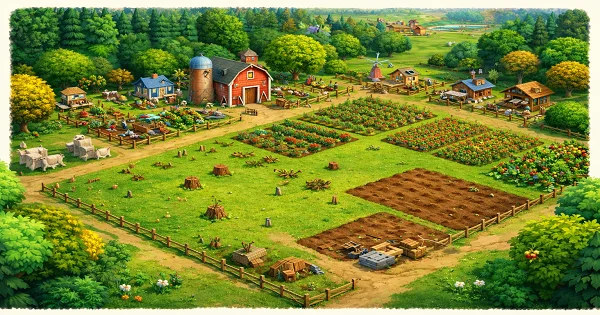
Expanding your farm in FarmVille 2 looks simple—clear land, place new buildings, and keep growing. But in practice, farm expansion is one of the most expensive and permanent strategic choices you make.
This PRO guide shows you when to expand, what to place first, and how to build a layout that stays fast even when your farm becomes huge. If you want more production without chaos, you’re in the right place.
1) How farm expansion really works
Farm expansion is not just “more space.” It’s a progress multiplier when done correctly—and a slowdown trap when done too early. Every new land plot you unlock adds flexibility, but it also increases your responsibilities: more items placed, longer walking paths, more clutter, and more decisions that can ruin your speed.
The “real cost” of expansion is not only the resources required to clear land. It’s also:
- Coins pressure (spending on land means less spending on production tools and upgrades)
- Time pressure (clearing + reorganizing layout)
- Efficiency risk (poor layout increases daily friction)
PRO players expand with a plan: space first, then speed. Casual players expand randomly and end up with a huge but slow farm.
2) Best time to expand (PRO timing)
The best time to expand is when your farm hits a space bottleneck that directly blocks production. If you can still run your daily routine smoothly (animals, crafting, harvesting, deliveries) without moving items constantly, you can delay expansion and invest into efficiency instead.
- You have no space to keep your key production buildings placed permanently
- You are forced to store/unstore items daily (huge time waste)
- Your layout is compact but still blocked by missing land
- You are ready to reorganize properly (not just “add random space”)
- You’re low on coins and still missing core upgrades
- Your Barn is always full (you’ll create more clutter, not more progress)
- You can’t commit to reorganizing (expansion without redesign = chaos)
PRO rule: expand for function, not for decoration. Your farm is a machine, not a museum.
3) What to place first on new land
The first items you place on new land decide if expansion becomes a power boost or a permanent mess. Most players waste new space on decorations or “random extra items.” PRO players place systems.
- Permanent production buildings (kitchen/workshop/crafting zones)
- Animal clusters (grouped by routine, not by “looks”)
- Storage flow (barn-related zones, staging area, crafting inputs)
- Delivery / collection area (a clear “work lane” you can tap fast)
- Decorations (only after everything above is stable)
If you expand and immediately place decorations, you usually end up deleting/moving them later. Expand once, build clean systems, then decorate only around stable zones.
4) Space optimization (advanced layout)
Bigger farms can be slower if your layout forces you to scroll, walk, and hunt for buildings. The goal is to build a layout where your daily taps are short, predictable, and grouped.
- Zone A: Production Core — kitchen/workshop + crafting inputs placed together
- Zone B: Animals — grouped pens/stalls with a clean tap path
- Zone C: Fields & Seasonal — crops + event items that change often
- Keep a clear lane (empty tiles) so tapping doesn’t miss objects
- Place “daily taps” close together (animals + key crafting)
- Never scatter the same building type across the map
- Don’t overfill: empty tiles are speed, not wasted space
PRO mindset: your farm should feel like a dashboard—everything important is reachable fast, without searching.
5) Expansion vs Barn Storage: what matters more?
Many players expand because they feel “stuck,” but the real bottleneck is often the Barn. If your Barn is full, extra land won’t solve it—you’ll just have more clutter.
- Your farm is organized but physically too tight for essential buildings
- You are forced to store/unstore buildings because of space
- You have stable Barn control (you’re not constantly capped)
- You hit “Barn full” every day
- You waste time selling useful items because you can’t hold them
- You can’t keep crafting inputs ready
PRO rule: Space helps only if you can store what you produce. Barn control comes first in most cases.
6) Common expansion mistakes (advanced)
- Expanding too early and going broke on coins
- Placing decorations first (then moving everything later)
- Scattering buildings across the whole map
- Filling every tile (looks big, plays slow)
- No zones → animals, crafting, crops all mixed together
- Rebuilding every week instead of creating stable “systems”
7) Final PRO rules (save these)
- Expand for function, not for looks.
- Build zones: production core, animals, fields/events.
- Keep empty tiles for speed and clean taps.
- Group the daily routine so you can play faster.
- Fix Barn pressure before going “bigger.”
- One redesign beats ten mini-expansions with chaos.
A big farm is not automatically a strong farm. A well-zoned farm is faster, richer, and easier to manage. Expand only when you’re ready to turn new land into a clean system—not into more clutter.
Leave a Reply